Does it hurt if an axolotl bites you?
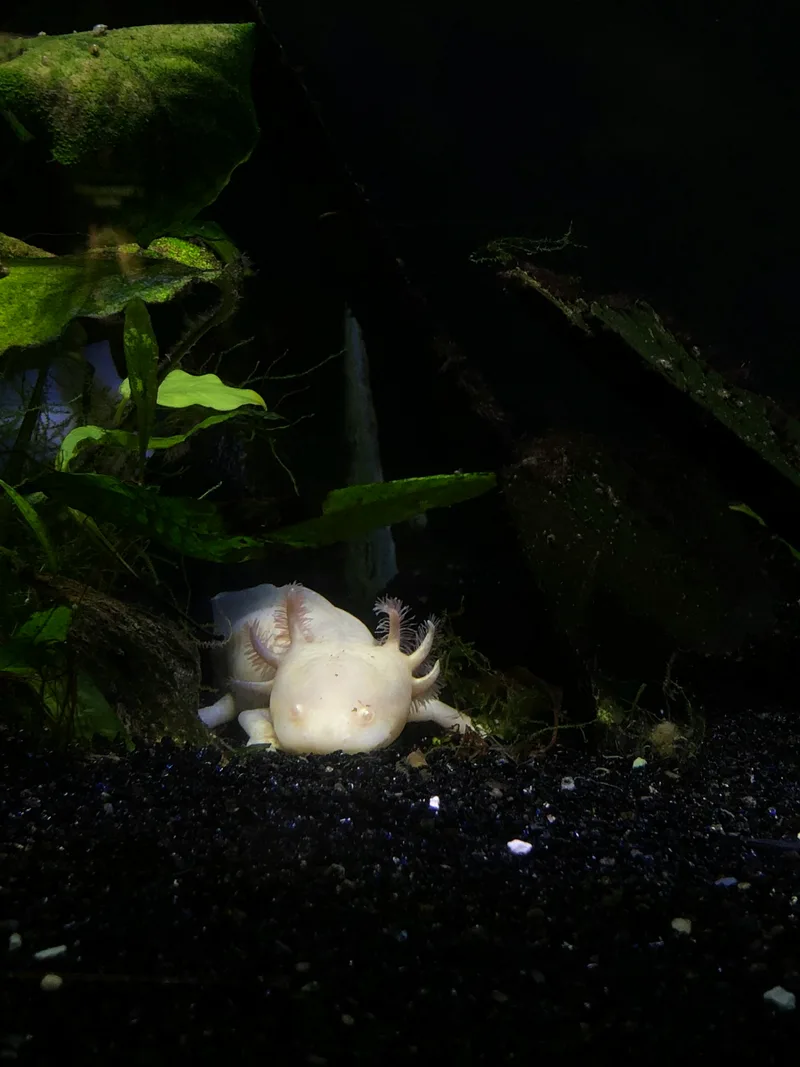
No. An axolotl bite almost never hurts, and it almost never breaks the skin, even though its mouth is full of teeth, with rows on the upper jaw, the lower jaw, and even across the roof. The catch is that none of those teeth are built to do you any harm, so a full bite from a fully toothed mouth still lands as a soft, startling pinch that's over before you've registered it. There's exactly one situation where a bite can genuinely surprise you, and it's worth knowing about. For the everyday case, though, the honest answer is that you're fine and so is your axolotl.
What does an axolotl bite actually feel like?
A typical axolotl bite feels like a blunt pinch or a quick suction-pull on your fingertip. More startling than painful. With a small or average-sized axolotl, the mouth clamps on for a fraction of a second, the axolotl registers that your finger isn't a worm, and it releases, usually before you've even pulled your hand back.
There's no piercing sensation and no sting. Afterward you can look at your finger and find nothing there: no puncture, no scratch, often not even a red mark. People who get bitten for the first time tend to describe it as anticlimactic. You brace for something sharp and instead get a damp little tug.
The bites happen most around the things that bring your hand near the mouth: feeding time, and reaching into the tank to clean or rearrange. An axolotl resting on the bottom isn't going to lunge across the tank to get you. It bites when your fingers come to it.
Why do axolotls bite in the first place?
It helps to stop thinking of the bite as the axolotl turning on you. It isn't aggression. It's a feeding mistake. An axolotl hunts largely by detecting movement near its face, and a wiggling fingertip drifting past its mouth reads as a worm. So it does what it does to a worm: it strikes.
This is completely normal behavior, and it says nothing bad about your animal. A confident, well-fed axolotl that snaps at your finger is just being an axolotl. The strike is fast and committed because in the wild a slow strike means the worm gets away.
You can sidestep almost all of it without much effort:
- Feed with tongs or a turkey baster instead of dropping food from your fingers, so your hand never becomes part of the meal.
- Don't dangle or wiggle your fingers in front of the mouth, especially right at feeding time, when the axolotl is primed to strike at anything that moves.
- When you need to do tank maintenance, move your hand in slowly and from the side rather than straight at the face.
Why doesn't it hurt? A look at how axolotls eat
The reason a bite can't really hurt comes down to how an axolotl eats. It isn't built to bite down and tear the way a predator with cutting teeth is. It's a suction feeder. When it strikes, it snaps its wide mouth open so fast that it pulls in a rush of water, and the prey comes along with the water. The force you feel is a gulp, not a chomp. It's the mouth sucking inward, not jaws crushing down.
The teeth fit that style of eating. Axolotls do have teeth, despite what you may have heard, but they're tiny, soft, and not really finished as teeth go. Their job is to grip a slippery worm and hold it in place long enough to be swallowed whole, not to puncture or slice. A worm is soft and wet and wants to wriggle free, so the teeth are made for holding, not for cutting. When that same mouth closes on your finger, you get the holding without anything behind it to do damage.
Did you know? The patch of teeth on the roof of an axolotl's mouth has its own name: the vomerine teeth. They sit in rows on a bone called the vomer and work with the jaw teeth to pin a worm in place from above and below at once. It's a clever little cage for holding wet, wriggling food still, and not one part of it is sharp enough to matter to your finger.
Can a bigger axolotl's bite ever hurt or break the skin?
There is one real exception, and it's the situation worth knowing about. A large, well-grown adult striking hard at feeding time can deliver a pinch with some real surprise behind it, and on rare occasions it can scrape or lightly break the skin. When that happens, it's usually not the bite force doing it. It's the startle plus the grip: the axolotl clamps on, you flinch and pull back, and your skin drags against those little gripping teeth on the way out.
That last part is the key to handling it. If a big axolotl latches on, the instinct is to yank your finger away, and that's exactly what scrapes you. Stay still instead and let the axolotl let go, which it will do almost immediately once it works out that your finger isn't food. Pulling against the grip is what does the damage, not the bite itself. If you do end up with a light scratch, rinse it under clean water and treat it like any other small scrape.
Even in this case it stays a non-event for you, and it's harmless to the axolotl too. A bite isn't a sign that something is wrong with the animal or that it can't be trusted around your hands. If a bite has you wondering whether you should be handling your axolotl much at all, the reasons their skin is best left alone have nothing to do with the small risk a bite poses to you and everything to do with how delicate that skin is. The bite itself is just the same precise feeding strike the animal uses on a worm, aimed by mistake at your finger. The very thing that makes it harmless, a soft mouth built to grip and gulp rather than crush, is the thing that makes the axolotl good at catching its food. Once you've felt one, it's hard to read it as anything more threatening than a case of mistaken identity.