How many axolotl morphs are there?
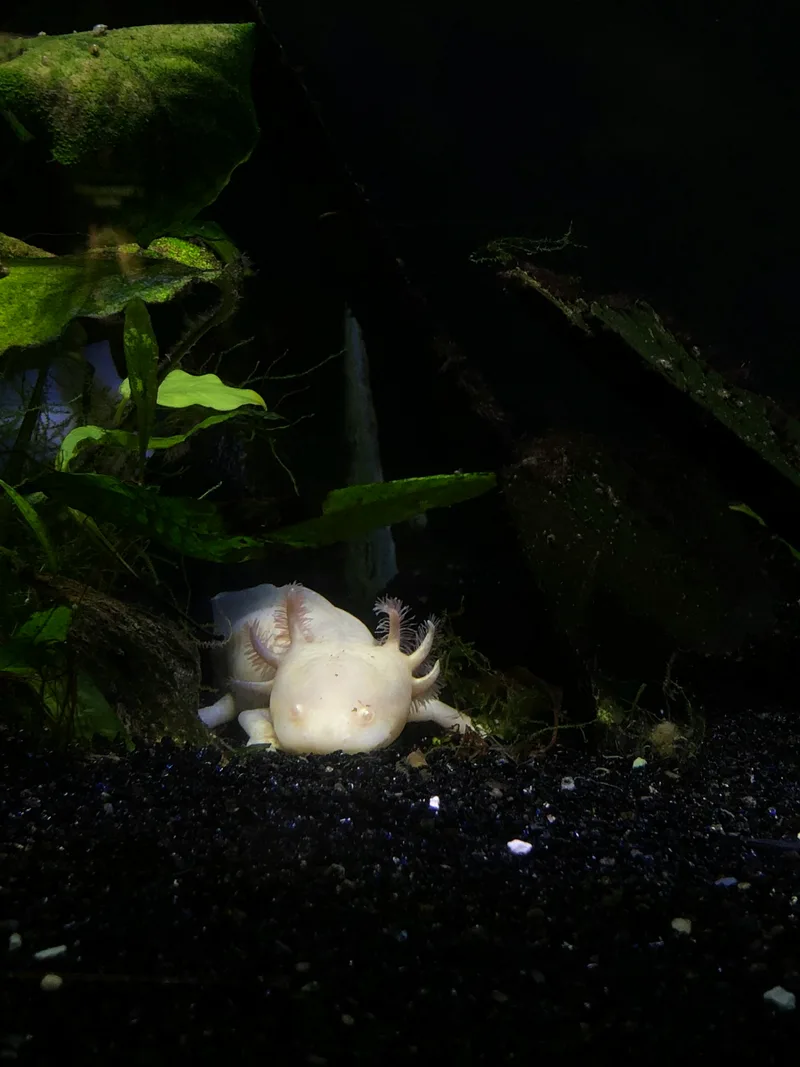
Six, if you count strictly: wild type, leucistic, white albino, golden albino, melanoid, and copper. Fifteen or more if you fold in pattern modifiers like piebald and dirty leucistic, plus the GFP transgene. Both numbers are honest answers to slightly different questions, which is why one site says seven, another says thirteen, and a third confidently lists fifteen and only describes six of them. The split lives in the pigment cells (chromatophores) under the skin.
Why morph counts disagree
Every axolotl's color comes from three types of pigment cells: melanophores (dark brown and black pigment), xanthophores (yellow and orange pigment), and iridophores (reflective, iridescent crystals). A "morph" is really a specific combination of which chromatophore types are present, absent, or altered. The confusion starts because different sources draw the line in different places.
Some sources count only the base genetic morphs, the ones defined by which chromatophores are switched on or off. That gets you to about six. Others fold in pattern modifiers like piebald or dirty leucistic, where the base genetics are the same but expression varies across the body. That pushes the count toward ten or twelve. And a few lists include GFP (green fluorescent protein) axolotls, mosaics, and chimeras, which aren't morphs in any genetic sense but show up in the hobby as named categories. That's where you see numbers like fifteen or higher.
| Layer | Examples | Approximate count |
|---|---|---|
| Base genetic morphs | Wild type, leucistic, white albino, golden albino, melanoid, copper | ~6 |
| Pattern modifiers | Piebald, dirty leucistic, high-iridophore | Variable |
| Transgenes and developmental oddities | GFP, mosaic, chimera | Not countable as morphs |
Below, each base morph gets its own section, followed by the pattern modifiers and oddities separately.
Wild type
This is the original axolotl coloration: dark olive-brown to greenish-black, flecked with gold or greenish iridescent spots along the sides and back. All three chromatophore types are working at full capacity. Melanophores lay down the dark base color, xanthophores add a faint yellow-green undertone, and iridophores scatter light as that distinctive metallic speckle.
Wild types are the baseline that every other morph is a subtraction or modification of. If you've seen a wild type next to a melanoid and thought they looked similar, the difference is in those iridophores. A wild type catches light. A melanoid absorbs it.
Did you know? Wild axolotls in Lake Xochimilco are almost exclusively wild type. The colorful morphs kept in tanks today were bred in laboratories and the pet trade, starting with a leucistic colony established at a Paris laboratory in 1863.
Leucistic
A leucistic axolotl (often called a "Lucy") has a pale pink or white body with dark eyes. It's the most popular pet morph by a wide margin, and probably the image most people picture when they hear "axolotl."
The genetics are straightforward: melanophore production is drastically reduced across most of the body, but not eliminated. Iridophores are still present, which gives leucistic axolotls a subtle shimmer that pure albinos lack. The dark eyes are the clearest way to tell a leucistic from a white albino at a glance.
Then there's the "dirty Lucy" variation. Some leucistic axolotls express melanophores more heavily, producing dark freckles, patches, or a dusting of pigment across the head, back, and gills. This isn't a separate morph. It's a spectrum within leucistic genetics, and the degree of "dirtiness" can vary a lot between individuals and even shift slightly as the animal grows.
The rarest axolotl morphs tend to come from less common genetic combinations, but leucistic axolotls remain the easiest to find in the pet trade precisely because that original Paris colony was leucistic.
White albino
At first glance, white albinos look similar to leucistic axolotls. The eyes give it away: red or pink instead of dark. The albino gene blocks melanin production entirely, so there are no melanophores functioning anywhere in the body. The pinkish or reddish tinge to the body comes from blood vessels visible through translucent skin, not from pigment.
White albinos have fewer active xanthophores than golden albinos, which is why they stay pale rather than turning yellow or gold. Their iridophores still function, giving them a faint pearlescent quality under certain lighting.
Because albino axolotls have no melanin protecting their eyes, they're more sensitive to bright light. If you keep a white albino, avoid placing the tank in direct sunlight or under harsh overhead lighting. Dim, ambient light or a tank with plenty of hides and floating plants works best.
Golden albino
Golden albinos carry the same albino gene as white albinos (no melanin, red or pink eyes), but their xanthophores are more active. The result is a warm yellow to golden body color that tends to deepen as the animal ages. A juvenile golden albino might look almost white, while an adult can take on a rich, buttery gold.
The same light sensitivity applies here. Without melanin, the eyes and skin have no UV protection, so moderate lighting and shaded areas in the tank matter. Care is identical for golden and white albinos. The only difference is how many xanthophores are expressing.
Melanoid
Solid dark brown to black, with a velvety, matte finish. They can look a lot like wild types, but the distinction is important: melanoids have no functional iridophores. Zero iridescent speckle, zero metallic shine. Where a wild type's skin catches light, a melanoid's absorbs it completely.
Melanophore density is also higher than in wild types, which gives melanoids a darker, more uniform color. Xanthophores are present but largely masked by the heavy melanin.
Melanoid axolotls can also appear lighter or darker depending on substrate color. An animal kept on pale sand may lighten noticeably over weeks, while one on dark substrate stays deep black. This is a normal physiological response (background adaptation), not a health concern.
Copper
Copper axolotls have a light brown, tan, or coppery body with a subtle warm sheen. Their eyes are lighter than a wild type's but not the red or pink of an albino. The trait is recessive, tied to a specific reduction in melanin that leaves a warm, brownish-gold tone rather than the cool dark of a wild type or the total absence of an albino.
Coppers are less common in pet stores than leucistic or wild type axolotls, but they've been gaining popularity with breeders over the past decade. If you're trying to distinguish a copper from a golden albino, check the eyes: copper axolotls have grayish or light-colored eyes with visible dark pigment, while golden albinos have true red or pink eyes with no melanin.
This rounds out the six base genetic morphs. Every other named variation you'll see in morph lists is either a pattern modifier applied to one of these six, a developmental anomaly, or a lab-introduced transgene.
Piebald, mosaic, and chimera
These three show up in nearly every morph list, but they sit in a different category from the base morphs above.
Piebald is a heritable pattern modifier, most commonly seen on a leucistic background. A piebald axolotl has irregular dark patches (melanophore clusters) on an otherwise pale body, often concentrated on the head and along the dorsal line. Because it's genetic, piebald parents can produce piebald offspring, though the pattern is variable. It's not its own morph; it's a modifier layered onto an existing one.
Mosaic axolotls result from a cell-division anomaly early in development. Two genetically different cell lines end up in the same animal, producing a blended or patchy mix of two morphs. You might see a leucistic-wild type split, or patches of albino and melanoid coloring on the same body. Because this happens at the cellular level during embryo development, you can't breed for it reliably. Two mosaic parents don't produce mosaic offspring.
Chimera axolotls are even rarer and arise from the fusion of two separate embryos into one animal. The result can look like a clean split down the middle, with one morph on the left and a different morph on the right. Like mosaics, chimeras can't be bred for. They're developmental accidents.
| Variation | How it happens | Heritable? | Appearance |
|---|---|---|---|
| Piebald | Genetic pattern modifier | Yes | Dark patches on a leucistic body |
| Mosaic | Cell-division anomaly during early development | No | Split or blended coloration from two morphs |
| Chimera | Fusion of two embryos | No | Distinct halves of two different morphs |
GFP axolotls
GFP stands for green fluorescent protein, a gene originally from jellyfish (Aequorea victoria) that was inserted into axolotl lines in research laboratories. Under normal light, a GFP axolotl looks like whatever base morph it carries. Shine a blue or UV light on it, and the skin, gills, and eyes glow bright green.
GFP is not a morph. It's a transgene that can be added to any base morph. You can have a GFP leucistic, a GFP wild type, a GFP albino. Once introduced into a line, the transgene is inherited like any other gene, so GFP axolotls do breed true for the fluorescence.
There are ethical and legal dimensions worth knowing about. GFP axolotls were created as research tools for tracking cell development, not as pets. Some regions and countries restrict or ban their sale. If you're considering one, check your local regulations first. The GFP gene itself has no effect on the animal's health or care needs.
How to identify your axolotl's morph
Start with the eyes. That single trait splits the field in half.
If the eyes are red or pink, you're looking at an albino lineage: white albino (pale body, minimal yellow) or golden albino (yellow to gold body, deepening with age). If the eyes are dark, move to body color and iridophore shine.
A dark body with iridescent speckling is a wild type. A dark body with no shine at all, matte and velvety, is a melanoid. A pale or white body with dark eyes is leucistic. And a warm brown or tan body with lighter (but not red) eyes is a copper.
| Eye color | Body color | Iridophore shine | Pattern | Likely morph |
|---|---|---|---|---|
| Dark | Olive-brown with gold flecks | Yes | Even speckling | Wild type |
| Dark | Pale pink or white | Subtle | None or minimal | Leucistic |
| Dark | Pale with dark patches | Subtle | Irregular dark spots | Piebald (leucistic) |
| Dark | Solid dark brown to black | None | Uniform matte | Melanoid |
| Light gray or tan | Light brown, coppery | Faint | Even | Copper |
| Red or pink | White or very pale pink | Faint | None | White albino |
| Red or pink | Yellow to gold | Faint | None | Golden albino |
If your axolotl doesn't fit neatly into one row, it may carry a pattern modifier (dirty leucistic axolotls can have enough dark pigment to confuse the call) or it may be a cross between two morphs. Juvenile coloring also shifts as axolotls mature, so an identification that seems off at four months might resolve itself by the time the animal is a year old.
All six base morphs and their variations trace back to one species from one lake. The color diversity sitting in tanks and pet stores around the world was built not by nature but by a century and a half of laboratory breeding and the pet trade, starting from a handful of wild-caught animals shipped to Paris. The axolotl's morph catalog is a human story as much as a biological one.