Are axanthic axolotls rare?
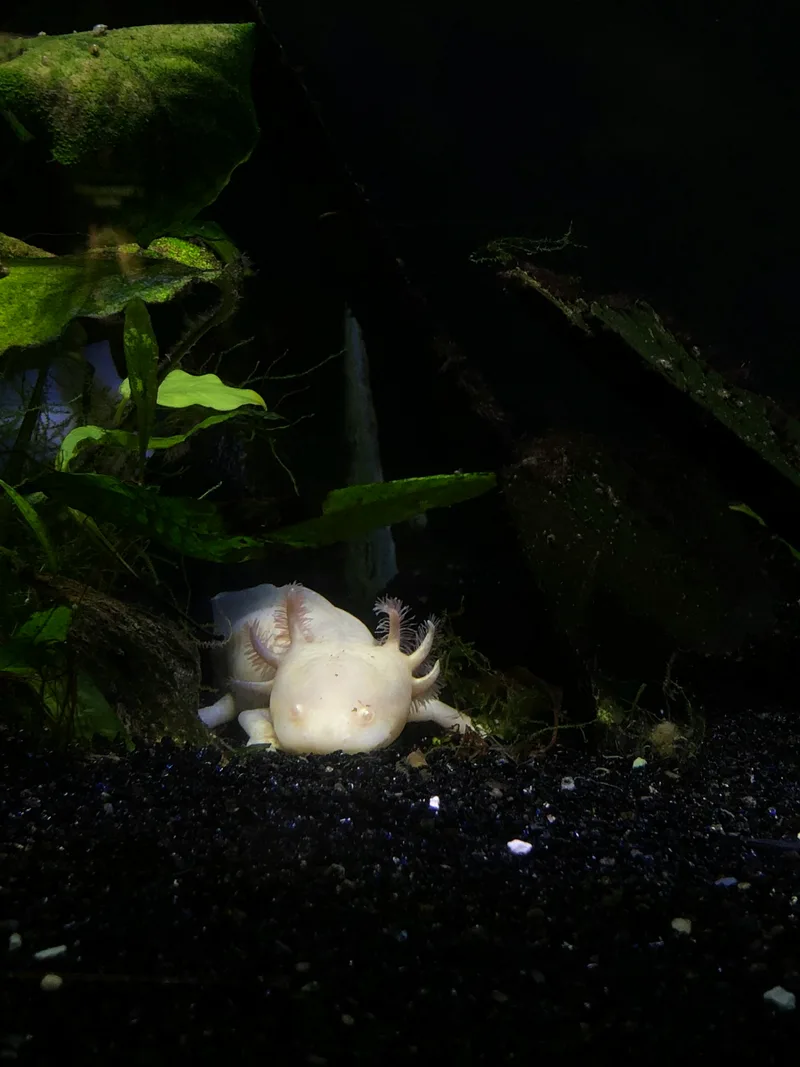
Uncommon, yes. Rare in the strict sense, no. A standard axanthic runs $50 to $75 from a specialty breeder and shows up on waitlists you can actually get to the front of. The melanoid axanthic copper (MAC), often called axanthic in casual conversation, runs $130 to $375 and stacks three recessive genes into one animal. Two morphs that share a name sit in completely different rarity classes, and the gap between them is where the real answer lives.
How Much Does an Axanthic Axolotl Cost?
A standard axanthic axolotl typically sells for $50 to $75 from a specialty breeder. That puts it above the common morphs (wild type, leucistic, and white albino usually run $25 to $45) but well below the multi-gene rarities. You won't find them at most pet stores. Axanthics almost always come from dedicated axolotl breeders who work with recessive color lines, and even among those breeders, stock sells out fast. Waitlists are normal.
The price climbs when you add genetic complexity. A melanoid axanthic runs $80 to $130, and the full melanoid axanthic copper (MAC) sits between $130 and $375, depending on the breeder and the animal's size. The jump in cost reflects the breeding difficulty: each additional recessive gene makes the cross harder to produce.
| Morph variant | Typical price range | Availability |
|---|---|---|
| Standard axanthic | $50–$75 | Uncommon; specialty breeders, often waitlisted |
| Melanoid axanthic | $80–$130 | Scarce; fewer breeders work this line |
| Melanoid axanthic copper (MAC) | $130–$375 | Rare; frequently sold out, long waitlists |
If you're shopping for an axanthic, go directly to a breeder with a reputation for healthy animals and honest genetics labeling. The breeder market for axolotls has grown, but so has the number of sellers mislabeling morphs. Ask for photos of the parents and confirmation that both carry the axanthic gene.
What Makes an Axolotl Axanthic?
Axolotls produce their color from three types of pigment cells: melanophores (which carry dark brown and black pigment), xanthophores (which carry yellow pigment), and iridophores (which contain reflective crystals that create a shiny, almost metallic sheen). A wild-type axolotl has all three working together, and the mix of dark, yellow, and reflective cells creates that familiar olive-brown mottled look.
An axanthic axolotl has nonfunctional xanthophores. The yellow layer is gone. What remains are the melanophores and iridophores, and without the warm yellow tones layered on top, the animal looks gray to silver, sometimes with a slight blue cast under certain lighting. It's the same underlying structure, minus one pigment line.
Did you know? Remove the yellow pigment layer from a wild-type axolotl and you don't get something dramatically different. You get a cooler, quieter version of the same animal. The dark pigment and reflective crystals are still there, just without the warm tones blending over them. That's an axanthic.
The trait is autosomal recessive, which means both parents must carry at least one copy of the axanthic gene for any offspring to express it. When two carriers are crossed, roughly one in four offspring will be axanthic (the classic Mendelian 25% ratio for recessive-by-recessive crosses). When you compare that to wild type or leucistic, where the trait is either dominant or produced by a more common allele, the math alone explains why axanthics are less common. It's not low demand driving the scarcity. It's the probability built into how the gene passes down.
Where Does Axanthic Rank Among Rare Morphs?
Rarity in axolotl morphs tracks pretty closely with genetic complexity. The common morphs are the ones that are easy to breed in volume: wild type (the default), leucistic (a single gene that suppresses pigment migration), and white albino (a single recessive knockout of melanin). These are the morphs you'll find at pet stores and general reptile expos.
Standard axanthic sits in the middle of the spectrum. It is a single recessive trait, but fewer breeders work with the line, and the 25% yield from carrier crosses keeps the supply lower than dominant-trait morphs. You can find one without extraordinary effort, but you'll probably need to seek out a breeder and wait.
At the far end are the multi-gene morphs: melanoid axanthic copper (MAC), mosaic, and chimera. MAC requires three recessive traits expressed simultaneously. Mosaic and chimera aren't genetic morphs in the traditional sense; they result from developmental anomalies (cell fusion or irregular cell division in the embryo), which means they can't be bred for at all. They just happen, rarely.
So axanthic is genuinely uncommon. It's not common, and calling it rare isn't wrong if you mean "you can't walk into a pet store and buy one." But it's not in the same class as a morph that requires developmental luck or three independent recessive genes.
What Is a Melanoid Axanthic Copper (MAC) Axolotl?
The MAC is where axanthic rarity compounds into something much harder to produce. It combines three separate recessive traits:
- Melanoid removes iridophores (the reflective cells), eliminating the shiny, metallic sheen
- Axanthic removes xanthophores (the yellow cells), stripping out warm tones
- Copper shifts the melanin pigment from dark brown/black toward a reddish-brown
The result is an axolotl with a soft lavender to pale purple appearance. No shine, no yellow, no deep black. Just a muted, almost pastel version of the animal.
Breeding a MAC means both parents must carry all three recessive genes, and the offspring must inherit the recessive allele from each parent at all three loci. The probability of that happening in a single cross is far lower than for any one trait alone. Breeders who produce MACs track bloodlines carefully and often work across multiple generations to build up stock with the right genetic combinations. Even then, a given clutch might only produce a handful of MACs out of dozens of larvae.
This is why MAC axolotls command $130 to $375 and frequently sit behind waitlists or out-of-stock notices. The demand is there, but the genetics make volume production impractical. A breeder can't simply pair two MACs and get a full clutch of MACs (though that cross does guarantee all offspring express the triple recessive). The bottleneck is having enough breeding-quality MAC adults to begin with.
Axolotl breeders have produced dozens of recognized morphs beyond axanthic and MAC, but the MAC illustrates a principle that holds across the hobby. The rarest morphs aren't the ones with a single unusual gene. They're the ones that stack multiple recessive traits into a single animal. As more breeders work with axanthic lines and axolotl popularity continues to grow, standard axanthics are slowly becoming easier to find. The combinations, though, stay rare. Stacking recessive traits is where scarcity compounds.