What are the downsides of owning an axolotl?
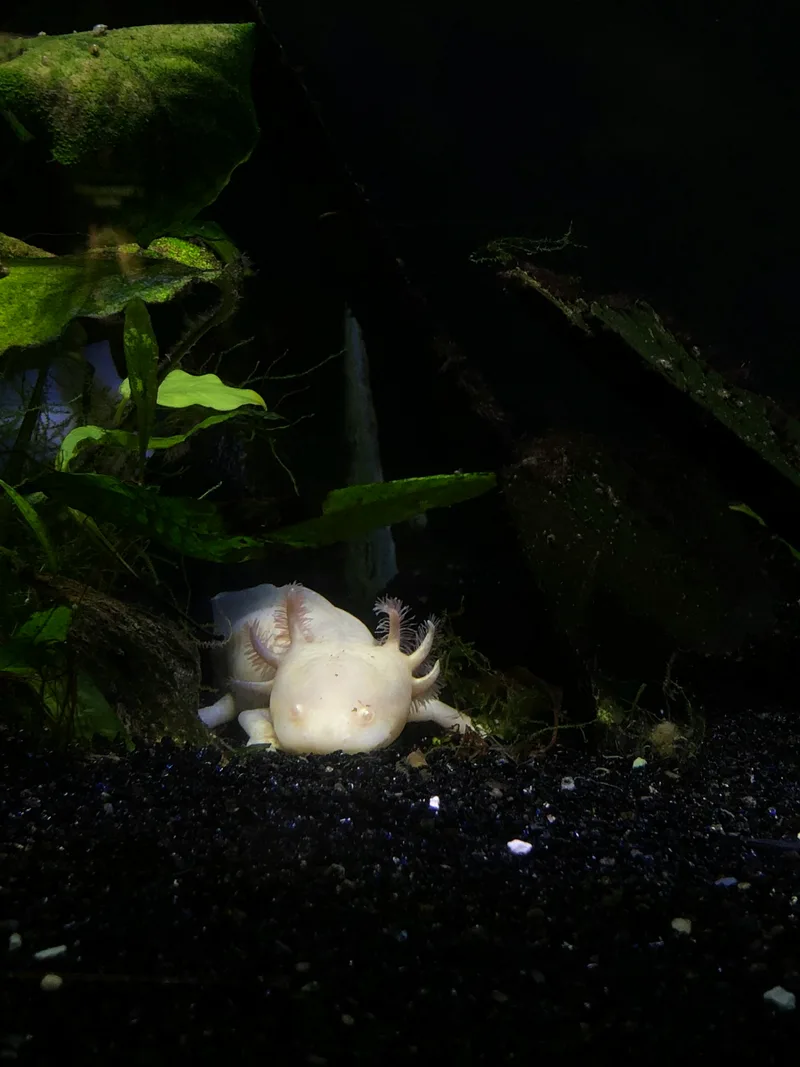
The downsides of owning an axolotl (Ambystoma mexicanum) come down to three things: they need cold water year-round, they have to live alone, and they're delicate, 10-to-15-year animals that don't tolerate normal fishkeeping instincts. The strange part is that almost every common axolotl death is caused by the things a new fishkeeper does automatically: adding a heater, picking out small gravel, dropping in a friend. The list below is short, but the cost of getting any single item wrong is usually the animal.
They need cold water, year-round
This is the dealbreaker most prospective owners underestimate. Axolotls do best at 60 to 64°F (16 to 18°C), and they start showing stress above 72°F (22°C). Anything past about 75°F (24°C) is dangerous. That rules out a heater, which is the easy part. The hard part is summer.
If you live somewhere the upstairs bedroom hits 80°F (27°C) in July, the tank will too. A standard fish-tank room, a sunny windowsill, a closed-up apartment during a heatwave: all of these are too warm for an axolotl whether or not you've added equipment. The cooling solution depends on the home: a quiet fan blowing across the water surface works for a few degrees, an aquarium chiller works for any climate but costs more than the tank itself, and a cool basement skips the problem entirely. Most beginners only find out their home runs hot the first August they own one.
The temperature is also where the axolotl's biology shows. They evolved in the cool, high-altitude lake complex around Mexico City, and their metabolism is tuned for it. Warm water speeds everything up (appetite, waste, oxygen demand) at exactly the moment their gill filaments are least able to keep up. That's why a heat-stressed axolotl looks restless and gasping rather than sluggish. Keeping the tank actively cooled instead of warmed is the rule that defines an axolotl setup, and the reason a heater is the one piece of standard fishkeeping gear that never goes in.
They have to live alone, no fish tankmates
An axolotl tank is a one-animal tank. Cold-water fish like white cloud minnows nip at the feathery external gills until the axolotl is bare and infected. Warm-water community fish need temperatures that hurt the axolotl. Small fish that would tolerate the cold end up eaten, and even when they aren't, fish-sized prey items can carry parasites the axolotl has no immunity to.
This isn't a preference. Axolotls evolved as ambush predators in a quiet, fishless lake system, sitting on the bottom and waiting for something to drift past. They never developed the social or defensive behaviors a fish in a community tank takes for granted. A flashy school overhead reads as either food or threat, never company.
Even a second axolotl is risky. Juveniles will bite each other's limbs off in territorial disputes, mistaking a passing gill or leg for prey. Two well-fed adults of the same size in a tank big enough to give them separate corners can sometimes work, but the safe default is one axolotl per tank. The trade-off worth understanding before you buy is that an axolotl is a solo aquatic pet, not the centerpiece of a community.
Most beginner setups can kill them
The dangerous part isn't that axolotl care is complicated. It's that the standard instincts of a new fishkeeper are wrong for this animal in specific, lethal ways. Almost everything that goes into a normal community tank is a hazard.
The most common ways a beginner tank kills an axolotl:
- Small-pebble gravel. Axolotls suck in food by gulping water, and they swallow whatever is near it. Pebbles small enough to fit in the mouth lodge in the gut and cause fatal impaction. Use bare bottom or fine sand only.
- Sharp décor. Their skin is soft, has no scales, and tears easily. Sharp slate edges, rough resin ornaments, and anything with small openings a foot or gill can catch in have to come out.
- Strong filter flow. Axolotls live in still water in the wild. A powerful filter outlet pinning them against the glass causes chronic stress and curled gills. Use a sponge filter or a baffled output.
- An uncycled tank. Buying the tank and the axolotl on the same day puts the animal in unestablished water. Ammonia spikes burn their gills before the bacteria catch up. Cycle the tank for four to six weeks before the axolotl moves in.
- A tank that gets above 72°F (22°C) in summer. Worth listing twice because it's the failure mode that catches owners who got everything else right.
The underlying mechanism on most of these is the same: axolotl skin is permeable, the gills sit out in the water exposed, and there's no protective scale layer. Whatever is in the water reaches the animal directly. Sharp things cut, warm water cooks, ammonia burns, and the axolotl's only defense is to mount a stress response that, sustained, eventually kills it.
They live 10 to 15 years
An axolotl in good conditions lives longer than most people expect when they pick one up. The commitment is closer to a medium-sized dog's than to a fish's, and it spans the parts of an adult life when things change the most: moves, jobs, relationships, kids, financial swings. All of those have to keep working around a 20-gallon tank that needs cold water and weekly maintenance.
Rehoming an adult axolotl is also genuinely hard. They're illegal as pets in several U.S. states (California, Maine, New Jersey, and Virginia have outright bans, and a handful more require permits). Even where they're legal, the audience for a used adult axolotl is small. Rescue groups exist but are usually full. The mental model worth holding before buying is that whoever sets up the tank is probably the one who keeps the axolotl for its entire life.
Did you know? An axolotl never finishes growing up. Their wild cousins eventually metamorphose into a land salamander, but the axolotl's body suppresses the hormone that drives that change, so they stay aquatic with feathery gills for life. The animal you buy at six inches is roughly the animal you'll have at twelve years, just larger. That stable form is part of why the lifespan stretches so long. They're never quite a juvenile, never quite an adult, just an axolotl. How long an axolotl actually lives in a home tank depends almost entirely on three things: temperature held under 72°F, clean water with no ammonia spikes, and a substrate that can't be swallowed.
They're a maintenance pet, not a play pet
Two downsides braided together. Axolotls produce a lot of waste for their size. They eat protein-heavy meals of worms and pellets, and most of what goes in comes out as ammonia. A 20-gallon tank with one adult axolotl needs a 20 to 30 percent water change every week, gravel-vac of the bottom, and a filter that's been cleaned often enough to keep up. Skip a week and the ammonia climbs.
The second half is that you can't really interact with the animal. Axolotl skin is covered in a delicate mucus layer that comes off on dry hands, leaving micro-abrasions that get infected. The gill filaments tear at the slightest tug. Handling stresses them out, and the stress shows up as gill curling, loss of appetite, and reduced immune function for days afterward. A vet appointment or a tank move is the only time an axolotl gets picked up, and even then it's done with a soft net or a cupped container of water, never bare hands.
So the daily relationship is closer to maintaining a planted aquarium than to keeping a pet that wants attention. The axolotl recognizes the person who feeds it, will swim over for food, and has visible moods (active, hiding, gill-flared, asleep on the bottom). What it doesn't do is meet you halfway. A reader who pictured a small aquatic dog will be disappointed; a reader who liked the idea of a strange, calm animal whose life happens behind glass will be exactly right.
So, is an axolotl right for you?
Four conditions have to be true for an axolotl to work. If any of them is a hard no, a different pet is the right answer.
| Right for you | Not right for you |
|---|---|
| Your home stays under 72°F (22°C) year-round, or you're willing to buy a chiller | Your home regularly gets warm in summer and you'd rather not deal with cooling |
| You're OK with one animal in one tank, no fish ambitions | You want a community tank with multiple species |
| You can plan around a 10-to-15-year commitment | You're not sure where you'll be in five years, let alone fifteen |
| You want a watching pet, not a handling pet | You want an animal you can interact with directly |
A "no" on temperature is the most common dealbreaker, and the one most worth being honest about with yourself. A "no" on the community-tank question often points toward a small school of tetras or a betta in a planted tank instead. Both give you the daily ritual of a fish tank without ruling out tank mates or warm rooms.
The downsides aren't reasons to talk anyone out of an axolotl. They're the reasons axolotls work the way they do. The cold water, the solo life, the long horizon, the watching-not-handling: these are the terms the animal comes with, and an axolotl in a setup that meets those terms is one of the most rewarding aquatic animals you can keep. The person who reads the list and thinks "yes, all of that fits" is exactly the person who should keep one. The person who feels a small flicker of relief at the off-ramp probably wanted a betta.