Are axolotls easy for beginners?
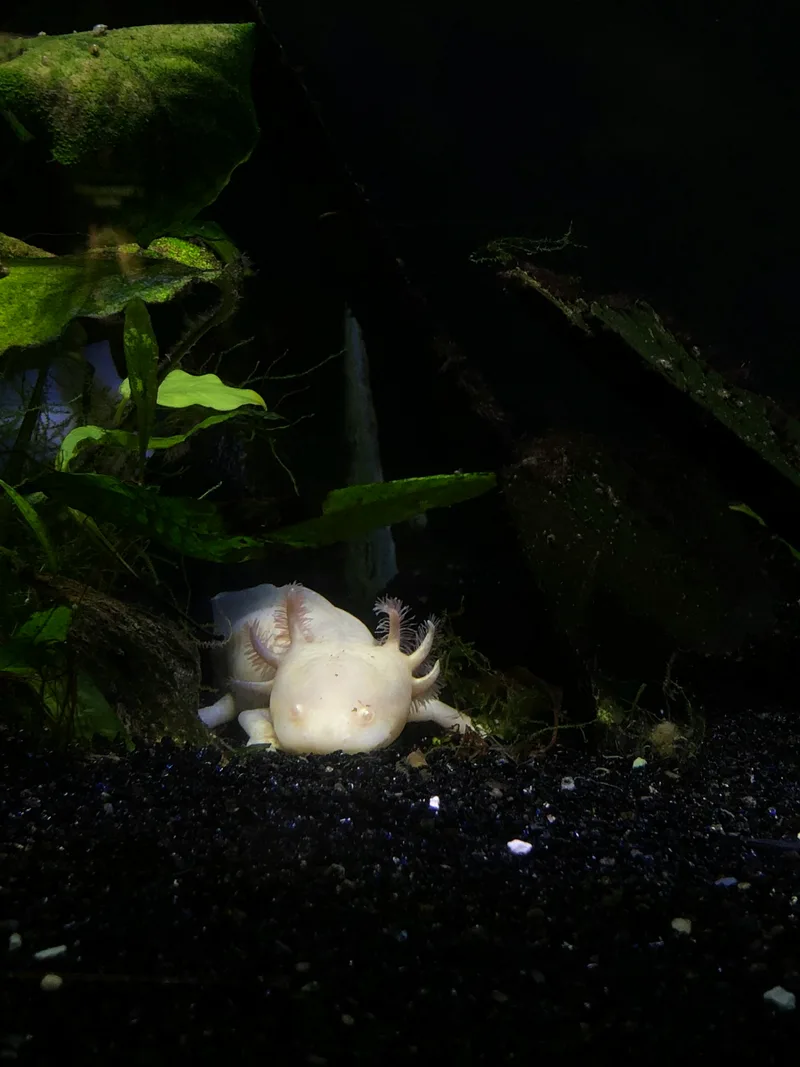
No, not for true beginners. The three habits that keep a tropical tank healthy (a heater, a small mixed community, a layer of gravel) are the same three habits that kill a first axolotl, usually within the first few months. Once the setup is right an axolotl is one of the easier aquatic pets to keep, but getting the setup right is where almost every first attempt goes wrong.
What would you actually have to commit to?
Four things decide whether an axolotl works in your house. None of them is hard on its own. All four together rule out a lot of homes that would do fine with a small tropical tank.
- Cool water year-round. Below about 68°F, ideally 60 to 64°F. That usually means a naturally cool room or a small aquarium chiller, not a heater.
- Solo keeping. One axolotl, no fish, no shrimp, no other axolotls unless you're committed to a much larger tank and you know what you're doing.
- Soft substrate. Fine sand or a bare glass bottom. No gravel, no pebbles, nothing the animal could pick up by accident.
- Specific diet. Earthworms, blackworms, or sinking axolotl pellets, offered by hand or with feeding tongs two or three times a week.
If you can answer yes to all four for the next decade or so, the rest of axolotl keeping is genuinely easy. If even one is a no, this is the wrong pet.
The cool-water rule is the one that catches the most people. Axolotls (Ambystoma mexicanum) come from a pair of cold, high-altitude lakes outside Mexico City. They have no behavioral or physiological tools for dealing with warm water. A room that sits at 75°F in summer is already past their comfort zone, and unlike a tropical fish you can't fix that with equipment you already own. You'd be buying a chiller, or moving the tank to a basement.
Where do beginners usually go wrong?
The three traps below account for most first-axolotl deaths, and all three come from the same place: applying tropical-fish habits to an animal that didn't evolve for them. Each one feels like normal aquarium setup. Each one is doing real damage.
| What feels normal | What actually happens | What to do instead |
|---|---|---|
| Installing a heater, or keeping the tank in a warm room | Anything above ~72°F stresses the axolotl; sustained warmth causes appetite loss, fungal infections, and eventually death | Aim for 60 to 68°F. Use a chiller, a cool room, or a fan blowing across the surface in summer. No heater |
| Adding fish "so it isn't lonely" | Fast fish nip the gills until they're stubs. Slow fish get swallowed whole and impact the axolotl's gut | Keep the axolotl alone. They don't experience loneliness; they experience tankmates as either prey or pests |
| Using standard aquarium gravel | Axolotls feed by suction and routinely vacuum up substrate. Gravel is too big to pass and lodges in the gut | Use fine sand (grain size under 1 mm) or no substrate at all. Fine sand passes through; bare glass is the safest option |
The heater trap is the worst of the three because it kills slowly. A warm axolotl looks fine for weeks. It eats less, sits in the same spot longer, and the gill filaments start to thin and curl forward. By the time the white fuzz of a fungal infection shows up, the animal has been declining for a while. Cold water isn't a preference for axolotls. It's the condition that keeps their immune system functional.
Adding tankmates is the move that sounds kindest and ends ugliest. An axolotl doesn't read other animals as company. Small fish get inhaled, often the first night. Larger or faster fish discover that the axolotl's external gills are slow-moving snacks, and the gills get nibbled down. Even snails and shrimp end up as food or as gut blockages. The right number of tankmates is zero.
Gravel surprises people most, because it's the default substrate on every starter kit shelf. Axolotls don't pick food off the bottom the way a corydoras does. They lunge and create a suction strong enough to pull up whatever's in front of them. Anything bigger than a grain of sand goes in and doesn't come out, and gut impaction is a slow, fatal problem that's hard to fix even at a specialist vet.
Are they easier once the setup is right?
This is the honest other half. A correctly set-up axolotl tank is one of the lowest-effort aquatic pets you can keep. Feeding is two or three times a week, not daily. Water changes are one bucket a week, maybe two for a larger tank. There's no algae arms race because the tank is cool and the lighting is dim. There are no aggression dynamics to manage because there are no tankmates. There's no breeding pressure because you have one animal. The animal itself is hardy in cold, clean water, eats a simple diet, and rarely gets sick.
That's the version of "easy" the marketing is reaching for. From inside a properly configured tank, an axolotl really is easier than a planted community tank or a pair of cichlids. The work is concentrated at the front: getting the temperature right, choosing the right substrate, accepting the no-tankmates rule, and stocking food the axolotl will actually eat. Once that's in place, the day-to-day asks less of you than almost any other aquarium pet.
Did you know? Axolotls keep their larval form for their entire 10 to 15 year life. They never lose their feathery external gills, never grow out of their finned tail, and never come up onto land. The trait is called neoteny, and they're the only salamander you can keep as a tank pet without ever having to build a terrestrial half.
What downsides should you weigh before deciding?
A few costs worth knowing about before the tank goes in:
- Length of commitment. Healthy axolotls live 10 to 15 years. That's longer than most dogs. The pet you set up at 25 is still with you at 40.
- Cooling cost. If your home runs warm in summer, you'll be running a chiller for several months a year. Small chillers start around $200, and they use electricity continuously.
- No handling. Axolotls are look-but-don't-touch. Their skin is permeable and damages easily. Move them with a soft net or a hand under the body, briefly, only when you have to.
- Limited vet access. Most small-animal vets don't see axolotls. A specialist exotic vet is the realistic option, and there may not be one within easy driving distance.
- Hard to rehome. Axolotls aren't a common pet. If your household changes (a move, a baby, a job change), placing the animal somewhere good is not as simple as posting a betta on Craigslist.
The real question isn't whether axolotls are easy. It's whether you're willing to keep a pet that breaks every fish-keeping rule for the next decade or more. Anyone who can answer yes will find an axolotl low-effort to keep alive long-term, and the most common reasons people regret the choice tend to be the ones that didn't get weighed honestly upfront. Anyone who can't answer yes isn't failing. They're saving an animal a hard life and themselves a hard ten years.