How many times a day should you feed goldfish?
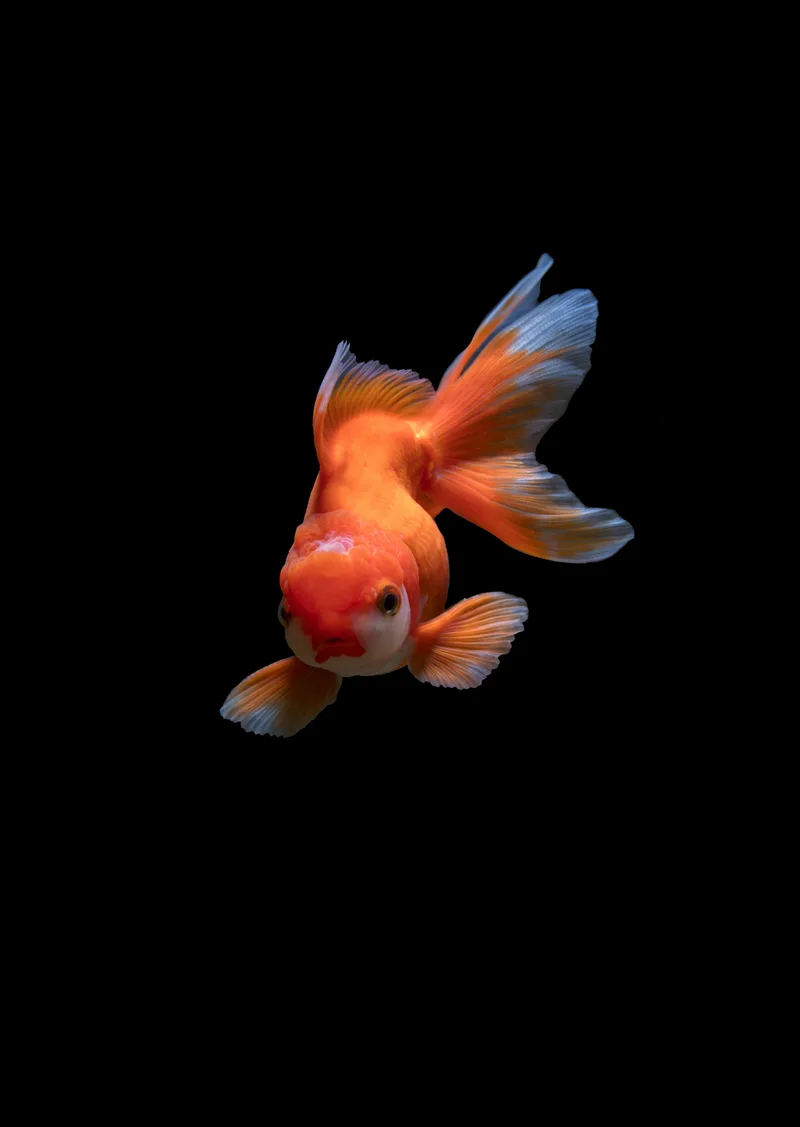
Most home goldfish do best on one to two small feedings a day, each no bigger than what the fish finishes in a minute or two, and when you are unsure, feed less rather than more. But the same goldfish (Carassius auratus) can need anywhere from a feeding or two a week to three a day, and nothing about the fish has changed. What changed is the water temperature. Goldfish are coldwater fish whose digestion slows as the tank cools, so the right number tracks the thermometer, and that's the part most feeding advice leaves out.
How Much Should Each Feeding Actually Be?
A feeding is done when the fish has eaten for about a minute or two and the food is gone. That's the whole rule. You are not measuring out a portion so much as watching the fish and stopping when it stops.
If you want a number to anchor to, the day's total food works out to roughly two percent of the goldfish's body weight. But you will never weigh your fish or its food, and you don't need to. The minute-or-two test gets you to the same place by watching instead of measuring. Drop in a small pinch, watch the goldfish work through it, and if it clears that pinch fast and is still hunting the bottom, that's the size of one feeding.
The signal that you have gone too far is food sitting on the bottom after the fish has lost interest. Uneaten flakes or pellets settling into the gravel mean the last pinch was bigger than the fish wanted. Cut the amount next time. A goldfish that's getting the right portion leaves the substrate clean.
Watching the fish itself tells you more than the clock does. A goldfish that comes up keen, eats fast, and goes back to grazing is feeding normally. If you want to read those cues more closely, a goldfish that is genuinely hungry versus just begging behaves in ways you can learn to spot, which takes most of the guesswork out of the portion question.
Does Water Temperature Change How Often You Feed?
Yes, and it's the part most feeding advice skips. Goldfish are coldwater fish, and like other fish they don't hold their own body temperature steady. They run at whatever temperature the water is. As the water cools, everything inside the fish slows down with it, including digestion. A goldfish in a cool tank physically cannot process food as fast as the same goldfish in a warm one.
That changes how often you should feed. In a cool winter tank, food moves through the fish so slowly that one or two feedings across a whole week is plenty. Push more in and it simply sits in the gut undigested. In a warm summer tank the fish burns through a meal quickly and can take two or three feedings a day without trouble. Same fish, same appetite to your eye, completely different needs depending on the thermometer.
Many goldfish are kept without a heater, so the water drifts with the season and the room. That makes the temperature reading worth checking before you settle into a feeding routine.
| Water temperature | How often to feed |
|---|---|
| 50 to 60°F (10 to 15°C) | Once or twice a week |
| 60 to 70°F (15 to 21°C) | Once a day |
| 70 to 75°F (21 to 24°C) | Twice a day |
| 75 to 80°F (24 to 27°C) | Two to three times a day |
Did you know? A goldfish has no true stomach. Food passes through a simple, straight gut with nowhere to be held and broken down in stages, which is exactly why many small meals suit it better than one big one.
Why Does Feeding Goldfish Too Often Cause Problems?
The reason "small and few" is the safe default comes down to how a goldfish is built. It has no true stomach, no pouch that holds a big meal and releases it slowly the way ours does. Food goes in one end of a straight gut and moves steadily through. The fish can't bank a large meal for later, so a big feeding doesn't get stored, it just passes through faster than the gut can absorb it.
That same plumbing makes overfeeding foul the water quickly. Goldfish already produce a heavy waste load for their size, and food that runs through undigested, plus the flakes that never got eaten, break down into ammonia. The water goes bad faster than you'd expect, and it's the water quality, not the extra calories, that does the real harm.
In round-bodied fancy goldfish like ranchus, orandas, and fantails, overfeeding has a second cost. Their compressed body packs the gut and swim bladder close together, so undigested food and the gas it produces can press on the swim bladder and throw off the fish's balance. The result is a goldfish floating sideways, sinking, or struggling to stay level, which owners often read as a disease when the cause was the last few oversized meals.
This is also where the common habit of a weekly fasting day comes from. Skipping food one day a week gives the gut a chance to clear and the tank a chance to recover, and for fancy varieties prone to buoyancy trouble it's a real reset. Foods make this better or worse too, and steering clear of the foods that swell or clog the gut keeps the water cleaner and the digestion smoother. Erring toward less isn't just caution. With a fish built like this, less is the kinder default.
Do Baby and Young Goldfish Need Feeding More Often?
Young, growing goldfish do better on three small feedings a day, while fully grown adults are fine on one or two. A juvenile is building its body fast and burns through food quickly, so spreading the day's food into more frequent meals fuels that growth without ever asking the gut to handle a big load at once.
The portions stay small. Three feedings a day for a young fish doesn't mean three large meals, it means the same minute-or-two pinch, just offered more often. The goal is steady fuel, not more food crammed in.
And the temperature rule still sits on top of the age rule. A young goldfish in a cool tank doesn't need three feedings a day, because cool water slows its digestion no matter how fast it's growing. Read the age and the thermometer together: warmth and youth both push the number up, cold pulls it back down. Past the idea that there's one correct figure, the goldfish itself is the most reliable guide you have. Watch how fast it clears each meal and how clean the water stays, and it will tell you the right frequency more honestly than any fixed schedule could.