What do axolotls need in their tanks?
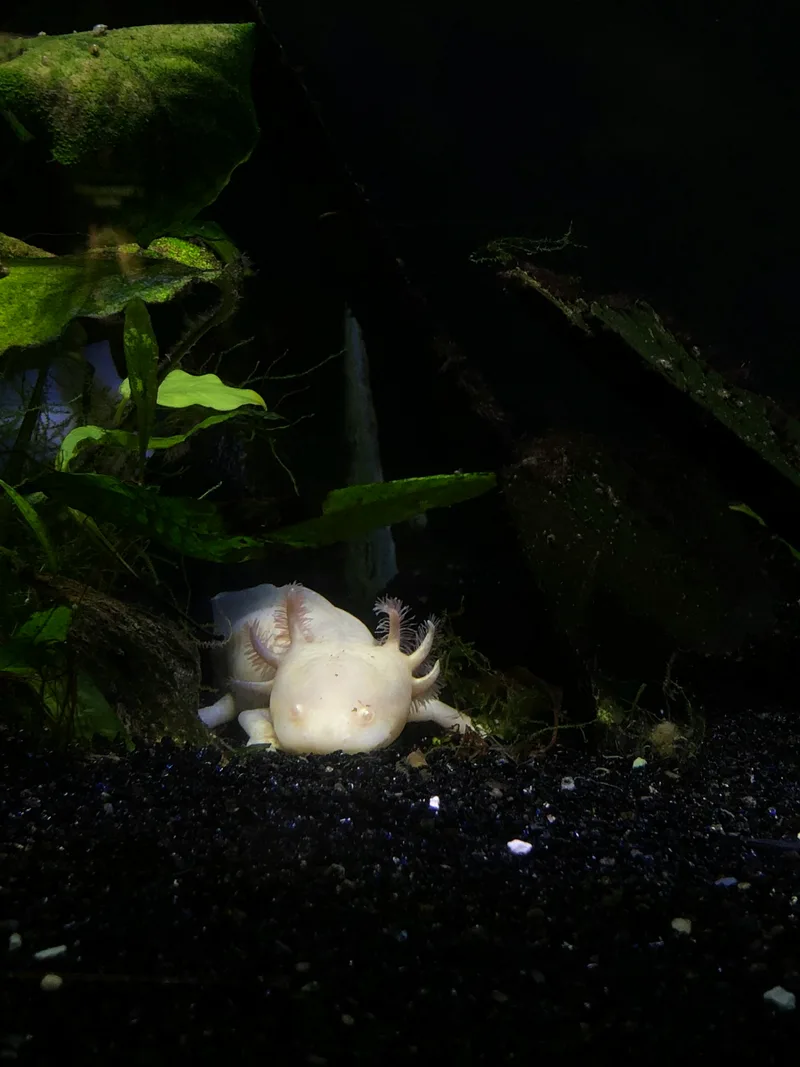
A cycled 20-gallon-long tank, cool water between 60 and 64°F, no heater, a gentle filter, a bare or fine-sand bottom, a few smooth hides, and nothing else living in the tank. Most of that list is what you take out of a normal fish tank, not what you add: no heater, no gravel, no community. Axolotls (Ambystoma mexicanum) are cool-water amphibians, not fish, and the three things that kill them most often in home care are the three fish-keeping defaults you'd be most sure you need.
A 20-gallon long tank, minimum
One adult axolotl needs at least 20 gallons (76 liters), and the footprint matters as much as the volume. Axolotls walk along the bottom rather than swimming through the water column, so a "20-gallon long" (30 inches wide by 12 inches deep) gives them far more usable space than a "20-gallon high" with the same number on the label. Floor space is the dimension that counts.
Adult axolotls reach 9 to 12 inches (23 to 30 cm) from nose to tail. A tank narrower than 30 inches feels cramped from the first day they settle in, and the behavior you see, hiding constantly, pacing the glass, reflects it. If you already have a 10- or 15-gallon tank on the shelf, treat it as a grow-out tank for a juvenile at best. It isn't a permanent home.
For two axolotls, plan on 30 gallons or more, though a solo axolotl is usually the safer setup regardless of tank size.
Cool water, and no heater
The single biggest mistake fish-keepers make is putting a heater on an axolotl tank. Axolotls live well between 60 and 64°F (16 to 18°C), tolerate down to about 50°F (10°C), and start to suffer above 72°F (22°C). A tropical setting of 76 to 78°F, normal for tetras or bettas, is a slow kill for an axolotl. They don't die in a day. They stop eating, lose weight, develop fungal infections, and fade over weeks.
The reason goes back to where they come from. Wild axolotls are endemic to the lake complex around Xochimilco in central Mexico, high-elevation water (around 2,200 meters) that stays cool year-round. Their whole physiology is built for that. Warm water raises their metabolism, which means they need more oxygen at exactly the moment the water holds less of it. Warm water also makes ammonia more toxic, and ammonia reaches an axolotl's bloodstream faster than most fish because their feathery external gills are in direct contact with the tank water. There's no internal gill tissue to buffer the exposure. The tissue meeting the water is the same tissue carrying the blood.
So instead of heating the tank, the job is usually to keep it cool. For most people in a normally heated house, that just means no heater and the tank in a cooler room. When summer rolls around and the room climbs past 72°F, you have options before things get serious.
- A small clip-on fan blown across the water surface will drop the tank 2 to 4°F through evaporation.
- Frozen water bottles floated in the tank buy a few hours during a heatwave. Rotate them from the freezer.
- A chiller unit is the expensive but hands-off fix for rooms that run warm year-round.
- Move the tank to the coolest room in the house (basement, north-facing bedroom) before summer, not during it.
- Tubbing the axolotl in dechlorinated water in the fridge (at around 40°F) is an emergency-only move for heatstroke or severe illness, not a standard cooling method.
Skipping the heater entirely is the right default for an axolotl tank, even when the room feels cold to you.
A cycled tank before the axolotl arrives
The tank has to be running the nitrogen cycle before the axolotl goes in. That means testing the water and reading ammonia at 0 ppm, nitrite at 0 ppm, and nitrate somewhere under 20 ppm. If any of those aren't true yet, the tank isn't ready.
Cycling in plain English: the bacteria that turn fish waste into safer compounds have to colonize the filter and substrate first, and growing a population of them takes time. When a tank is brand new, ammonia from the animal's waste builds up with nothing to process it, nitrite builds up as the first wave of bacteria catches up, and only after both of those spike and settle does the tank stabilize. For a fishless cycle (the only kind you should do with an axolotl), this takes 4 to 6 weeks with a bottle of pure ammonia dosed to 2 to 4 ppm, a heater (yes, a temporary one) in the low 70s to speed bacterial growth, and a test kit used two or three times a week.
Axolotls are unusually sensitive to ammonia for the reason described above: their gills curl out from their heads like feathers, and every capillary in them is in direct chemical contact with the water. A fish has bony gill covers and internal gill filaments that give the tissue some structural buffer. An axolotl does not. What's in the water is what's in the bloodstream, faster and more directly.
Did you know? Axolotl gills curl forward and go pale under ammonia stress. The reaction happens at the tissue level, before the animal does anything about it. It's one of the clearest "the water is wrong" signals in the hobby, because the organ meeting the water is literally on the outside of the body.
Once the tank reads 0 / 0 / under 20, remove the temporary heater, do a large water change to bring the temperature down into the 60s, and then bring the axolotl home.
Bare bottom or very fine sand, and nothing in between
Gravel and small pebbles are the second most common way axolotls die. Axolotls hunt by suction: they open their mouths wide near whatever they want to eat and the food gets pulled in with a rush of water. Anything sitting near the food gets pulled in too. A swallowed pebble can lodge in the gut, block digestion, and kill the animal over days. A vet can sometimes image the blockage and recommend fasting or manual passage, but impaction is often beyond fixing by the time the symptoms show.
You have two safe options, and one dangerous one that shows up in older care guides.
| Substrate | Safe? | Looks | Cleaning | Notes |
|---|---|---|---|---|
| Bare bottom | Yes | Plain, obvious seam of glass and silicone | Easiest. Siphon daily if you want, weekly minimum. | The safest choice. Juveniles under 5 inches should be kept this way until they outgrow the risk of swallowing their own substrate. |
| Fine sand (under 1mm grain) | Yes for adults (15 cm / 6 inches and up) | Natural, softens the tank look, lets the axolotl grip while walking | Moderate. Stir it weekly to release trapped waste, siphon the surface. | Use pool-filter sand or aquarium sand specifically labeled under 1mm. Passes through the gut if swallowed. |
| Gravel, pebbles, large stones | No | Natural, classic aquarium look | Easy to siphon between pieces | The "they can't swallow it" argument fails because axolotls grow. What's too big on Tuesday fits on Sunday. Old forum advice, current consensus is to skip it. |
If you're setting up a new tank and the animal is a juvenile, start bare-bottom and switch to fine sand later if you want the look. You lose nothing by waiting and you lose the animal if you don't.
A gentle filter with low flow
Axolotls produce a lot of waste, which means the tank needs strong biological filtration. They also hate fast water, which means that filtration has to move quietly. That tradeoff is the whole filtration question in one sentence.
The simplest solution is a sponge filter driven by an air pump. The air bubbles lift water through the sponge, the sponge houses the bacteria that do the nitrogen work, and the output is barely a trickle. One large sponge or two medium sponges in a 20-gallon long tank is usually enough.
A hang-on-back filter or a canister filter also works, but only if the output is softened. A flow reducer on the outlet, a baffle made from a cut plastic bottle, a spray bar aimed at the side wall instead of across the tank, or a sponge pre-filter on the intake will all calm the current. The test is visual: drop a leaf of dead anubias into the tank and watch it. If the current pushes it across the tank, the flow is too strong for an axolotl. If it drifts slowly or sits where you put it, you're in the right range.
Signs the flow is still too much even after you think you've baffled it:
- The gill filaments (the feathery branches on the sides of the head) sit pinned flat against the head instead of fanning out.
- The axolotl drifts away from the output every time it tries to settle.
- It parks on the far side of the tank and stays there.
- The gills look "clamped" against the body, with no movement.
- It stops eating, especially if feeding means approaching the part of the tank where the current is strongest.
Any two of those together mean the filter needs more baffling or a lower flow rate.
A few smooth hides and some cool-water plants
Axolotls are shy animals and benefit from at least one hide per axolotl in the tank, somewhere they can wedge in and be fully covered. A hide isn't decoration, it's a place to feel safe enough to rest, and an axolotl with nowhere to rest spends more time stressed.
The rule for hides is smooth surfaces only. Axolotl skin has no scales and scrapes on anything sharp. Terracotta pots laid on their sides (the drainage hole sanded smooth or taped), PVC pipe cut to length and with the edges filed, and purpose-built resin caves sold for axolotls are all good. Skip anything with rough driftwood, sharp rock edges, or plastic mesh. Run your hand along the surface before you put it in the tank: if it catches on your skin, it'll catch on the axolotl's.
Plants are optional but help the tank stay dim (axolotls prefer low light) and pull some nitrate out of the water between water changes. The species that do well in a cool, low-light axolotl tank are also the easiest plants in the hobby:
- Java fern (Microsorum pteropus), tied to a rock or piece of driftwood rather than planted in sand
- Anubias (Anubias barteri and its smaller cousins), same rules as java fern
- Java moss, either floating or tied down
- Hornwort, tough and fast-growing, forgiving of cool water
- Amazon frogbit, a floating plant that shades the surface and blocks bright light
- Elodea (Egeria densa), sometimes sold as anacharis, tolerates the cold well
Most tropical aquarium plants (dwarf sagittaria, cryptocoryne, stem plants sold for high-tech setups) will slowly melt in a cold, dim tank. If you want a planted axolotl tank, stick to the list above and accept that growth will be slower than in a warm, well-lit tank. That's the tradeoff for keeping the animal comfortable.
No tank mates, not even other axolotls
An axolotl tank is a solo tank by default. This is the hardest part of the list for fish-keepers to accept, because a fish tank with one fish in it feels wrong, and the instinct is to fill the rest of the footprint with something. Resist the instinct. Every category of fish tank mate creates a specific problem for axolotls.
Active fish like any tetra, any barb, or most rasboras will nip at the axolotl's gills, which look like food to them. The axolotl can regrow damaged gills, but it loses condition in the process, and constant low-level harassment stresses it toward illness. Small fish, ghost shrimp, and snails fall on the other side: they fit in the axolotl's mouth and they will be eaten, often along with a mouthful of substrate that causes the impaction problem discussed earlier. And most of the fish people like in a community tank (rasboras, gouramis, corydoras) need water above 72°F to thrive, which an axolotl cannot survive long-term.
Pairing two axolotls is a different kind of risk. Two axolotls in one tank mistake each other's gills and toes for food with depressing regularity, especially when they're young and everything that moves is food. Axolotls regenerate bitten limbs and gills, which is part of what makes them famous, but regrowing a leg takes weeks of energy the animal could have spent growing or healing from something else. And two axolotls produce double the waste, which means double the ammonia pressure on an animal whose gills are already the most exposed in the hobby.
The list of species that genuinely belong with an axolotl is very short, and keeping just one axolotl avoids most of what goes wrong in the first year. The default is one axolotl, alone, in a tank set up for one axolotl.
How to put it all together
The whole list turns into a short shopping trip and a six-week calendar.
- 20-gallon long tank (30 inches wide, minimum)
- Fitted lid (axolotls jump when startled)
- Sponge filter with air pump and airline tubing, or a hang-on-back filter with a baffling plan
- Dechlorinator (Seachem Prime or equivalent)
- Liquid test kit (API Freshwater Master Kit covers what you need)
- Pure ammonia for cycling, or a handful of hardy plants
- Fine aquarium sand (under 1mm) or nothing at all
- One or two smooth hides: terracotta pot, PVC pipe, purpose-built cave
- Thermometer (stick-on or digital)
- Clip-on fan, in case summer runs warm
The order of operations matters as much as the list. Set the tank up empty, on a stand that can hold the weight. Rinse the sand if you're using it and add it to the tank. Fill with dechlorinated tap water. Get the filter running. Start fishless cycling: dose to 2 ppm ammonia, test every few days, wait for ammonia and nitrite to both read zero and for nitrate to appear. That takes 4 to 6 weeks. Do not rush this part. Only once the water reads 0 / 0 / under 20 do you drop the temperature into the 60s, let it stabilize for a day, and bring the axolotl home.
None of this is harder than a fish tank. It's just different. An axolotl tank isn't a fish tank with an amphibian in it. It's a quiet, cool, empty pool with one animal in it, and every decision on the list follows from that picture. Once you see the tank that way, most of what feels like a new set of rules is really the old ones removed. You're not learning axolotl-keeping so much as unlearning fish-keeping, and the animal in the tank will tell you pretty quickly when you've got it right.