What does a stressed axolotl look like?
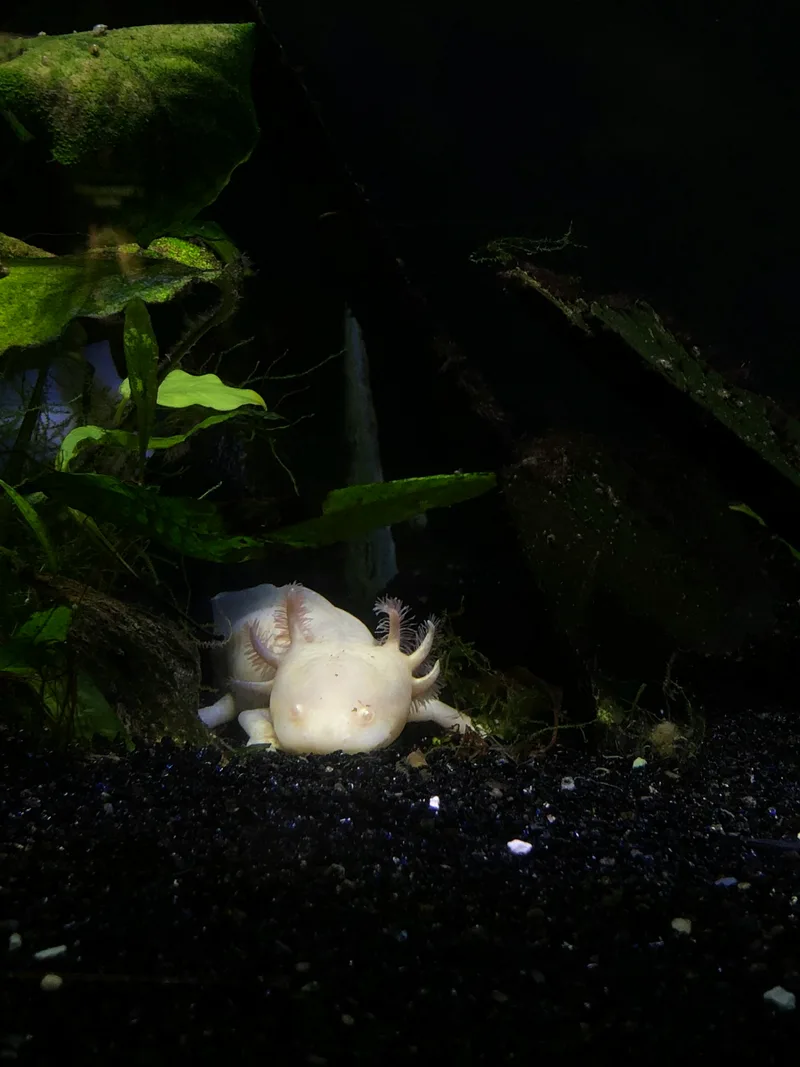
A stressed axolotl tells you with its body. The gills curl forward toward the face, the tail tip hooks into a question-mark shape, and in some cases the back arches or the skin flushes red. If your axolotl is doing something odd but its gills fan out normally and its tail hangs straight, you're probably looking at normal behavior. When multiple physical signs show up together, something in the water or the environment needs to change. Below is how to read what you're seeing, what to do about it, and when to worry.
How do I tell stress from normal axolotl behavior?
Axolotls do weird things. They glass-surf, they float, they sit perfectly still for hours. Most of the time, one odd behavior on its own is just an axolotl being an axolotl. Stress shows up as a cluster of physical changes, not a single quirk.
A few common scenarios and how to read them:
- Glass-surfing (swimming up and down the glass repeatedly). On its own, this is usually exploration, especially in a new tank or after a water change. If the gills are curled forward at the same time, that's stress.
- Gill position. Relaxed gills fan out from the head like small feathery trees. Stressed gills press forward toward the face, sometimes going stiff and upright with a "candy cane" curve. A momentary flick forward is nothing. Gills locked forward for hours is a problem.
- Tail position. A relaxed tail trails loosely behind. A stressed tail hooks at the tip, curling upward or sideways like a question mark. This is one of the most reliable single indicators.
- Redness or flushing. In leucistic and albino morphs, a pink or red flush through the skin can be completely normal after activity or feeding. Persistent, deepening redness that doesn't fade within an hour or two points to irritation or stress.
- Floating or buoyancy problems. Occasional floating near the surface, especially after eating, is common. Persistent floating where the axolotl can't seem to swim back down is different and usually signals a water quality issue or swallowed air.
- Stillness and appetite. Axolotls are naturally sedentary. Sitting still at the bottom is their default. But if your axolotl stops eating for more than two days and barely moves when food passes by, pair that with a check of the gills and tail.
The pattern matters more than any single sign. An axolotl with fanned-out gills, a straight tail, and a good appetite is almost certainly fine, even if it's doing something you haven't seen before. An axolotl showing healthy, relaxed body language has soft gill filaments that sway gently in the water and a loose, trailing tail.
What should I do if my axolotl looks stressed?
Start with the water. Water quality is behind most axolotl stress, and the fix is simple once you know what's off.
- Test your water parameters. Check ammonia, nitrite, nitrate, and temperature. Ammonia and nitrite should both read zero. Nitrate should be under 40 ppm. Temperature should be between 60 and 68°F (15 to 20°C).
- Do a partial water change. If ammonia or nitrite are above zero, or nitrate is high, do an immediate 25 to 50% water change with dechlorinated water matched to tank temperature.
- Check the temperature. If it's above 72°F (22°C), that alone can cause stress. Cool the tank by floating ice bottles (sealed, frozen water bottles) and increasing surface agitation for oxygen exchange.
- Look for environmental stressors. Strong filter current pushing the axolotl around, bright overhead lighting with no hides, gravel substrate (impaction risk), or tankmates nipping at gills. Remove or fix what you find.
- Consider tubbing if parameters are dangerous. If ammonia or nitrite are spiking and you can't get them down quickly, moving your axolotl to a clean, cooled tub of dechlorinated water buys time while you fix the main tank.
Most stress signs start to reverse within 24 to 48 hours once the cause is removed. Gills that were curled forward begin to relax outward again, and the tail uncurls. If you're unsure what your target water parameters should be, test first and adjust from there.
What causes stress in axolotls?
Axolotls are cold-water amphibians that evolved in the still, murky canals of Xochimilco. They have no eyelids, no streamlined body for fighting current, and a metabolism that runs best in cool water. Almost every stress trigger comes back to a mismatch between what the tank provides and what the animal is built for.
| Stressor | Why it stresses them | What you'll see | Quick fix |
|---|---|---|---|
| Ammonia or nitrite spike | Xochimilco's canals are fed by springs and rainfall that keep dissolved waste near zero. Axolotl gills are fully exposed to the water, so any ammonia hits gill tissue directly, unlike fish that can partly close their opercula. | Curled gills, redness, frantic swimming, gasping at the surface | Immediate 50% water change; check if the tank is cycled |
| Temperature above 72°F (22°C) | The canals of Xochimilco sit at about 6,500 ft elevation and stay cool year-round, rarely topping 68°F. Axolotl metabolism, immune function, and oxygen uptake are all tuned to that range. Warm water holds less dissolved oxygen, and their exposed gills can't compensate the way a fish's can. | Increased activity, floating, rapid gill movement, refusing food | Float frozen water bottles, increase surface agitation |
| Strong current | Xochimilco's canals are slow-moving to nearly still. Axolotls have a wide, flat body and large external gills, neither of which is built for swimming against flow. In a river-like current they burn energy just staying in place. | Axolotl bracing against the glass or hiding constantly, curled tail | Baffle the filter output, reduce flow rate |
| Bright lighting | The canals are shallow but murky with dense vegetation and floating cover overhead. Axolotls have no eyelids and rely on dim, filtered light. Direct bright light is something they literally cannot shut out. | Retreating to hides during all lit hours, curled gills | Switch to dim or indirect lighting, add floating plants for cover |
| Gravel substrate | The natural canal bottom is fine silt and mud. Axolotls feed by snapping up prey with a suction motion that pulls in whatever is near the mouth. Gravel is too large to pass through the gut, unlike the soft sediment they evolved to accidentally ingest. | Bloating, constipation, lethargy (signs of impaction) | Switch to fine sand or bare bottom |
| Tankmates | Wild axolotls are solitary ambush predators. They don't school, and any animal close enough to touch their gills is either prey or a threat. Their regenerative ability offsets occasional nips in the wild, but constant harassment in a closed tank outpaces it. | Nipped gills, stress posture, hiding | House axolotls alone or only with others of similar size |
Temperature is the one that catches you off guard. Axolotls aren't tropical. Water above 72°F speeds up their metabolism, lowers dissolved oxygen, and makes them vulnerable to fungal infections. A room that feels comfortable to you can be too warm for the tank, especially in summer.
Is my axolotl stressed or sick?
Stress and illness overlap, but the timeline tells you which one you're dealing with.
Stress is reversible. Fix the environment, and the signs fade within a day or two. The gills unfurl, the tail straightens, appetite comes back. If you've corrected every parameter and removed every obvious stressor and the signs are still there after 48 hours, you're likely looking at something beyond stress.
Signs that point toward illness rather than stress alone:
- White cotton-like patches on the skin or gills (fungal infection)
- Open sores or red lesions that don't fade
- Gills that are deteriorating, losing filaments, or shrinking over time
- Persistent floating with no ability to swim down, even in clean, cool water
- Refusal to eat for more than a week despite good water conditions
When you see these, the next step is a salt bath or a consultation with an exotic vet who handles amphibians. Online axolotl communities (Caudata.org, dedicated subreddits) can also help you identify what you're seeing from photos. An axolotl showing signs of illness needs targeted treatment, not just cleaner water.
Did you know? Axolotls can regenerate damaged gills. Mild gill deterioration from a stress episode often reverses completely once conditions improve, with new filaments growing back over a few weeks. That regenerative ability is part of why catching stress early matters so much: the damage doesn't have to be permanent.
The stress signs your axolotl shows (curled gills, hooked tail, flushed skin) are specific, readable, and almost always fixable. Your axolotl is communicating something concrete through its posture, and now you know how to read it. Most of the time, the answer is in the water.