How to tell if an axolotl is happy?
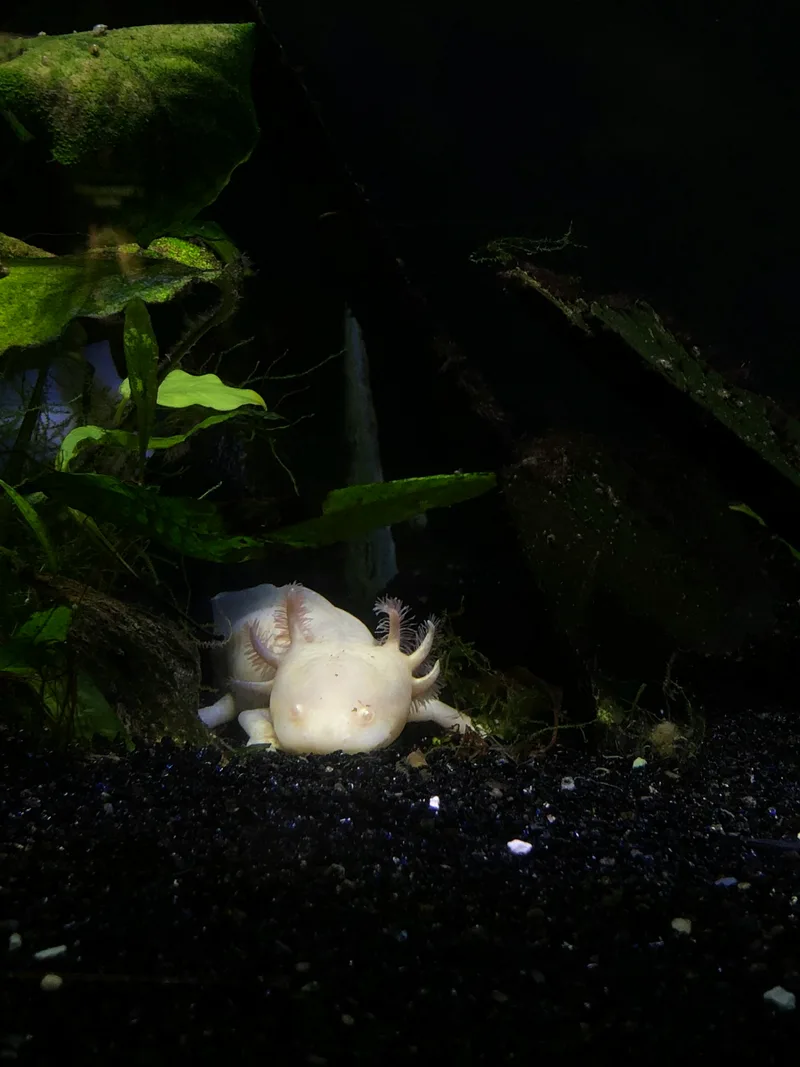
A content axolotl (Ambystoma mexicanum) shows it through a few reliable physical signs: full, feathery gills fanned out to the sides, a straight and relaxed tail, a steady appetite, and calm movement along the bottom of the tank. If your axolotl looks like that right now, it's doing well. Below is what each of those signs actually tells you, what the warning signs look like when something is off, and why the gills are the single best thing to keep your eye on.
What Does a Happy Axolotl Actually Look Like?
You can check most of these in a few seconds just by watching your axolotl where it sits.
- Full, fluffy gills fanned to the sides. The gill filaments (the feathery branches on each stalk) should look full and spread outward, not pressed flat or curved forward over the head. This is the quickest thing to check.
- Straight tail. A relaxed axolotl holds its tail straight or with a gentle, natural curve. If the tip is curled upward or the tail is kinked into a U-shape, something is bothering it.
- Willing to eat. A healthy axolotl takes food readily. It doesn't have to be aggressive about it, but when you offer a worm or pellet, it should show interest within a few seconds.
- Calm bottom-walking with occasional exploring. Axolotls spend most of their time sitting on the bottom or walking slowly across it. Short bursts of swimming up to the surface to gulp air are normal. What you don't want is frantic laps around the tank or hours of floating at the top.
- Relaxed stillness. An axolotl that sits on the substrate without clamped gills or a rigid body posture is resting comfortably. This is fine and can go on for hours.
- Gill color that matches the morph. A wild-type axolotl has dark, reddish-brown gills. A leucistic has bright red ones. Whatever the color should be for your axolotl's morph, healthy gills hold that color without white fuzz, gray patches, or unusual redness at the base.
If your axolotl ticks most of these boxes, you're in good shape. Not every axolotl will be active and exploratory; some sit in one spot for most of the day, and that's normal temperament, not a problem.
What Does a Stressed Axolotl Look Like?
The warning signs are just as visible as the good ones, and each one points toward a likely cause, so you have a next step instead of just a worry.
- Gills curved forward over the head. This is the most common early stress signal. It usually points to poor water quality (ammonia or nitrite above zero) or a chemical irritant in the water. Test your water first.
- Curled tail tip. The tail tip curls upward or to the side instead of resting straight. This is a general stress response and often shows up alongside other signs. On its own it can mean the axolotl is just momentarily startled, but if it persists, check your parameters.
- Refusing food. An axolotl that turns away from food it normally takes may be dealing with water temperature that's too high (above 68°F / 20°C), an ammonia spike, or the early stages of illness. A single skipped meal isn't a crisis, but several in a row is worth investigating.
- Persistent floating. Occasional trips to the surface for air are normal. An axolotl that stays floating for long stretches, especially if it looks like it's struggling to swim down, may have swallowed air (gas buildup) or may be reacting to poor water quality. An axolotl that keeps floating and can't swim back down needs a different troubleshooting path than one that floats briefly and returns to the bottom.
- Frantic gill flicking. Rapid, repeated flicking of the gill stalks, different from the slow, occasional gill flutter you'll see in a healthy axolotl, often signals a chemical irritant in the water. Dechlorinator issues, medication residue, or a cleaning product that got into the tank are common culprits.
- Total stillness with clamped gills. An axolotl that doesn't move, holds its gills tight against its head, and shows no interest in food is in serious distress. This can indicate advanced water quality problems or illness, and it needs attention right away: test your water, check the temperature, and consider a 100% water change into clean, dechlorinated water at the right temperature.
Most of these stress signs share a common first step: test your water. Ammonia and nitrite should both read zero in a cycled tank, and nitrate should stay below 40 ppm. Temperature should be between 60 and 68°F (15 to 20°C). If any of those are off, you've likely found the problem. Recognizing the full range of stress behaviors helps you act faster when something changes.
Why Are the Gills the Best Thing to Watch?
Most animals keep their respiratory organs inside their bodies. Axolotls wear theirs on the outside, and that turns the gills into a live dashboard for how the animal is doing.
The feathery filaments on each gill stalk are where gas exchange happens: oxygen in, carbon dioxide out. When the water is clean, well-oxygenated, and the right temperature, those filaments grow long and branch out to maximize surface area. You see this as thick, well-branched gills. When conditions deteriorate (rising ammonia, low oxygen, warm water), the filaments shrink back. The gills look thinner, shorter, and may curl forward as the axolotl tries to protect them.
This is why gill condition tracks current water quality so closely. An axolotl with beautiful gills today and shrunken gills next week is telling you something changed in the tank between then and now.
Did you know? Axolotls can regenerate their gills entirely. If the filaments are damaged or bitten off by a tankmate, they'll grow back over a few weeks. That means gill condition is always a readout of current conditions, not a scar from something that happened months ago. The gills you see today reflect the water your axolotl is living in right now.
Water flow matters here too. Axolotls come from still or slow-moving water, and a filter output pointed directly at them can stress the gills just as much as a water quality issue can. If the gills look irritated but your parameters test fine, check whether your filter is pushing too much current.
Do Axolotls Have Personalities, or Are You Reading Too Much Into It?
You're not imagining it. Axolotls do show individual behavioral differences. Some are bold and walk right up to the glass when you approach. Some hide in their cave all day. Some lunge at food the moment it enters the water; others wait and think about it. These differences are consistent enough that most keepers can tell their axolotls apart by behavior, not just by color.
What's actually happening is a mix of individual temperament (which varies between animals the way it does in most vertebrates) and conditioned responses. An axolotl that swims to the front of the tank when you walk into the room has learned to associate you with feeding. That's a real learned behavior, not projection on your part. Axolotls can learn to recognize and respond to their specific owner, though what that recognition actually involves is more limited than it looks.
But calling any of this "happiness" or "bonding" stretches the word past what amphibian neurology supports. Axolotls don't have the brain structures that generate emotions the way mammals do. What they have is observable behavior: approach or avoidance, feeding response or refusal, relaxed posture or tense posture. Those behaviors are real, measurable, and worth paying attention to.
"Happy" is a human word. The signs it points to, though (good gills, relaxed body, steady appetite), are not human at all. They're specific, observable, and they tell you whether your axolotl is thriving in the conditions you've given it. You don't need to know what your axolotl feels to know it's doing well. Watching for those signs is the whole job.