Do axolotls bond with owners?
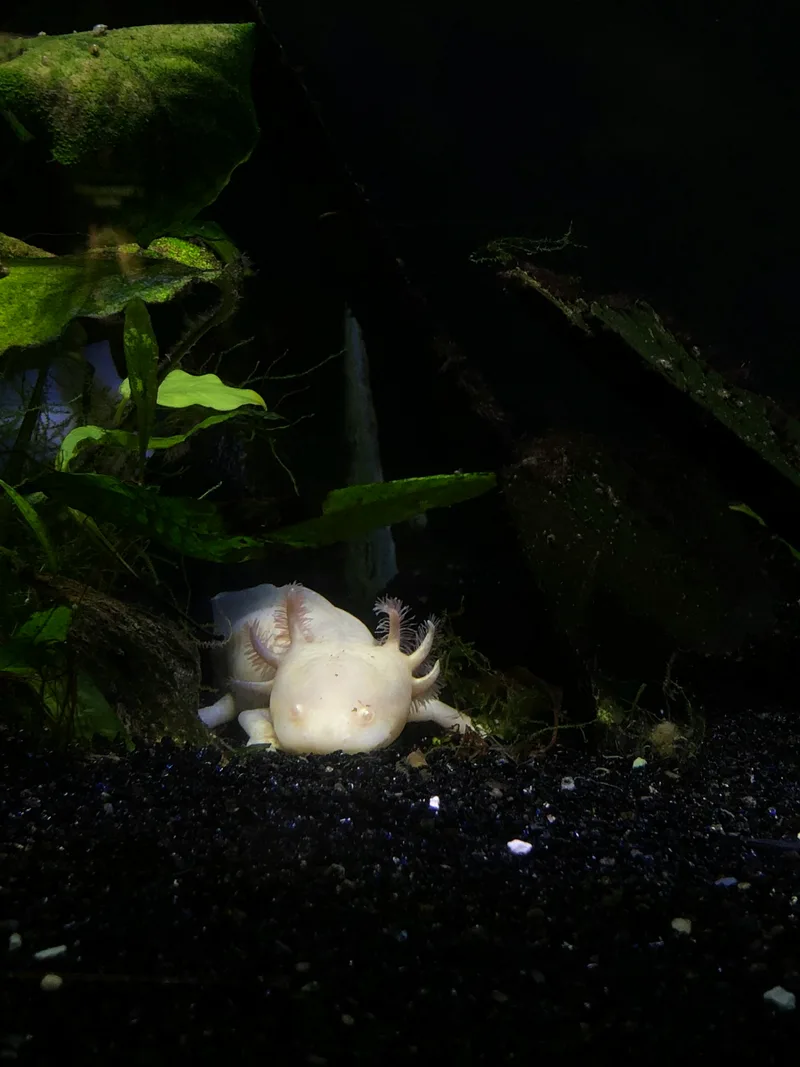
Not really, and that's fine. Axolotls don't form emotional bonds the way dogs or cats do. They don't have the neural hardware for attachment. But they do learn to associate a specific person with food and routine, and the behaviors you're noticing at the glass (the swimming over, the wiggling, the staring) are real. They're just not affection in the mammal sense. Below is what you're actually seeing, why the animal works this way, and how to build a routine that works for both of you.
What Are You Actually Seeing When Your Axolotl 'Greets' You?
The behaviors owners read as affection are learned responses. Your axolotl has figured out that when a certain shape appears in front of the glass, food usually follows. That's not nothing. It means the animal has learned to distinguish you from other stimuli in its environment, and it means your routine is consistent enough for it to predict what comes next. That is the axolotl version of knowing you.
Here's what each common behavior is actually tracking:
- Swims to the glass when you approach. It's responding to your movement and the vibration of your footsteps. You are a large, predictable shape that has always meant food.
- Slow tail wiggle at the front wall. An anticipatory feeding response. The axolotl is orienting toward the expected food source and positioning itself to strike.
- The stare (facing you from the substrate). It's detecting water-pressure changes your movement creates at the surface. This looks like eye contact, but the axolotl is reading ripples, not your face.
- Comes out of a hide at feeding time. The strongest evidence of learned routine. The axolotl has internalized the timing or the sequence of cues (lights, footsteps, fridge opening) that precede feeding.
- Opens its mouth as you reach for the tongs. A gape response triggered by the visual cue of the feeding tool. Pure association, remarkably fast to develop.
None of these are random. They all point to an animal that has learned your patterns. The relationship is just built from prediction and association rather than attachment.
Why Axolotls Can't Bond the Way a Dog or Cat Does
Axolotls are neotenic salamanders (they keep their larval body plan for life), and their brains reflect that. There is no limbic system producing the kind of social attachment you see in mammals. No oxytocin loop, no pair-bonding circuitry, no reading of faces or voices. Their sensory world is built around water movement, shadows, and chemical traces dissolved in the water column.
What they do have is associative learning. An axolotl can learn that a stimulus predicts an outcome (your footsteps predict food, a sudden shadow predicts nothing dangerous) and adjust its behavior accordingly. That is genuine learning. It is just not emotion.
This also explains why axolotls don't bond with each other. They are solitary animals. Two axolotls in the same tank tolerate one another at best and bite each other's gills at worst. The animal simply doesn't have a bonding system to offer anyone, human or otherwise.
Did you know? Axolotls hunt largely by detecting water-pressure changes through tiny sensors called the lateral line (the same organ fish use). When your axolotl "looks up at you," a lot of what it's actually doing is reading the ripples your footsteps and hand movements make across the surface.
How Do I Build a Routine My Axolotl Will Actually Recognize?
You can work with the axolotl's wiring instead of against it. The goal is to become a predictable, non-threatening presence that the animal associates with food and calm.
- Feed on a consistent schedule. Same time each day, same approach. The axolotl will learn the sequence of cues (your footsteps, the fridge, the tongs) and begin responding before you even open the lid.
- Approach the tank calmly. Quick movements register as predator cues. A slow, steady approach lets you become a shape the axolotl has filed under "not a threat."
- Keep room lighting steady. Axolotls are sensitive to sudden light changes. If you flip the room light on and off unpredictably, you're resetting their sense of safety each time.
- Skip the glass-tapping. It creates a pressure wave that startles the animal. What looks like the axolotl "responding" to tapping is usually a flinch, not recognition.
- Do not handle the axolotl. This is the opposite of bonding for this species. Their slime coat is delicate and functionally important. Your body temperature (around 98°F) is dangerously warm for an animal that needs water in the low 60s°F. Stress sets in fast. Handle only for medical reasons or when tubbing is necessary.
Over a few weeks of consistent routine, most axolotls become noticeably more responsive to their keeper. They come out earlier, orient faster, and stay at the glass longer. That responsiveness is the relationship.
If Not Affection, How Can I Tell My Axolotl Is Doing Well?
The better question isn't "does it love me?" but "is it healthy and unstressed?" A content axolotl looks like this: active around dusk and dawn, external gills full and feathery (not curled forward), good appetite, relaxed posture flat on the substrate with limbs spread naturally. It doesn't hide all day. It doesn't float at the surface or hang vertically.
Early stress signs run the other direction. Gills curled forward against the head, loss of appetite, frantic swimming along the glass (which looks different from the calm approach at feeding time), and pale or darkened skin tone compared to the animal's baseline.
Your axolotl showing signs of comfort and activity tells you more about the relationship than any greeting behavior does. And if you're seeing the opposite, recognizing stress signals early makes most problems fixable before they become serious.
The relationship is real. It is shaped by what an axolotl actually is: a cool-water salamander with a lateral line and a feeding schedule that has learned the shape moving in front of the glass is the one that brings worms. That's its own quiet kind of recognition, and it doesn't need to be dressed up as something else to matter.